
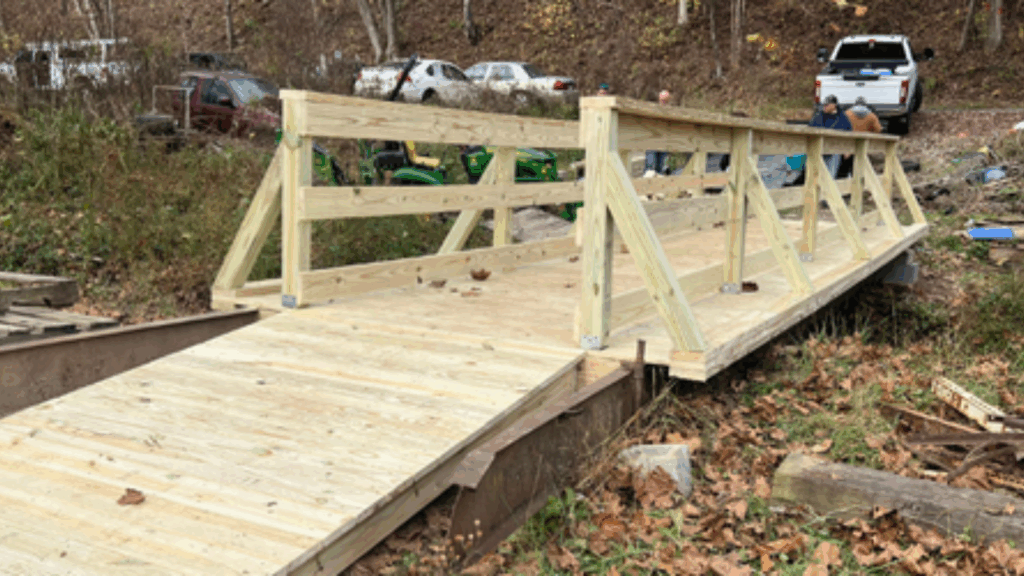
Recently, there was a family who needed a bridge. Their small home sat in a rural part of West Virginia, and the only way to reach the road was by crossing a narrow footbridge over a creek. The bridge had fallen into disrepair, and the condition was quietly brought to the attention of local Child Protective Services (CPS) as a safety concern. The children in the home needed to cross that bridge every day to catch the bus for school. The family was doing their best but could not afford the repair.
In an effort to help the family, CPS staff reached out to a trusted local church to see if they could help. That church had partnered with Chestnut Mountain Village to launch a Family Advocacy Ministry and had been active in the community for several years providing prayer, meals, childcare, encouragement and relational support for families, as well as other activities to meet practical needs. The FAM ministry model is a simple and sustainable way for churches to support foster, adoptive, kinship, and vulnerable families.
Over those years, the FAM Advocates at the church developed genuine trust with local Child Protective Service workers through National Hospitality Week, service projects for vulnerable families, and volunteer roles that kept the Advocate connected with CPS staff. It was this foundation of trust and a relationship built over time that prompted CPS to reach out to the local church when the unsafe footbridge came to their attention.
At first, the church dismissed the request as it felt far beyond their capabilities. Their volunteers were trained to provide meals and childcare, not to build bridges. As the Advocate later explained, “We didn’t feel like we had the skills, the resources, or the know-how, but the Lord kept bringing this request back to us, so we decided we could send someone to take a look.”
A church member with construction experience visited the home and assessed the bridge. He reported that the project was likely manageable in a single day with a small team, but the materials would require funds far beyond the ministry budget. Once again, it seemed there was a gap between what the family needed and what the church could provide, but the Lord was still working behind the scenes.
In a follow up conversation, the Advocate explained the situation to the CPS worker. The CPS professional immediately shared that designated state funds were available to purchase the necessary materials. They simply needed someone willing to oversee the project and complete the work. Within a few short weeks, the effort was coordinated, the supplies purchased, the volunteers organized, and the project completed. The family now has safe and reliable passage to their home.
Those who care for children and families know that gaps appear every day, but it does not have to be that way. In this story, everything the family needed already existed in their community, but there were gaps. There was a gap between those who saw the need and those who held the resources. There was also a gap between two different organizations, each carrying a key piece of the solution.
When the Advocate was asked, “How did this happen?” she shared with a big smile, “God made a way.”
With trust, communication, and steady collaboration, the Lord used the relationship between the church and CPS to bridge those gaps and provide what was needed for this family and these children. As organizations, agencies, and churches build deeper trust and work together, we will see more bridges and fewer gaps for West Virginia’s children and families.
Your financial gift to The Village strengthens the partnerships that close these gaps, allowing more children and families to receive the practical, life-changing support they need. Prayerfully consider making a one time or monthly gift to support West Virginia’s most vulnerable children and families.